
July 2026 - Volume 2
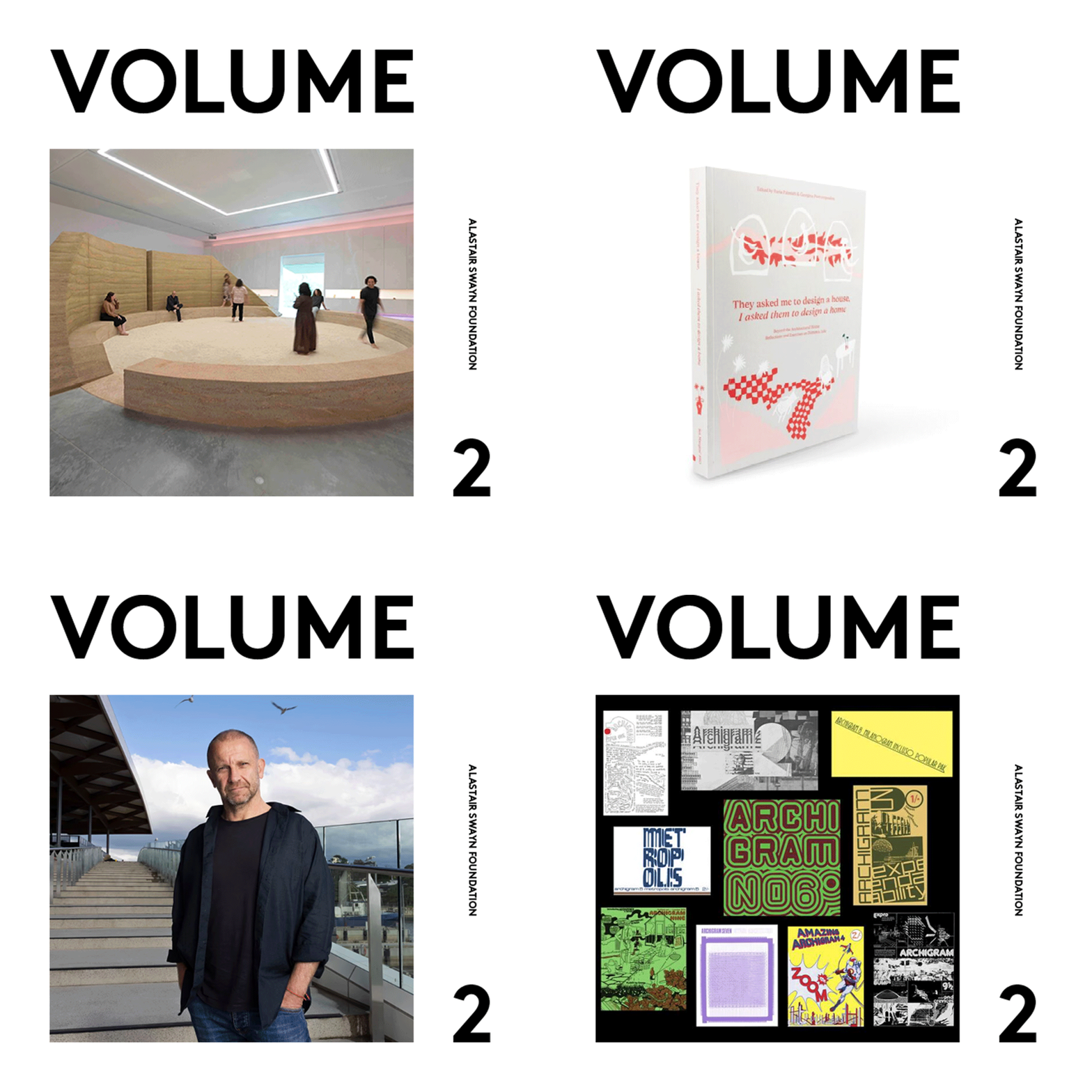
In this newsletter we start with a fun exercise – making a coffee cup from coffee. Then we get to the serious business and look back at the last Venice Architecture Biennale and forward to the next, which were and will be supported by the Alastair Swayn Foundation. We present just some of the commentary following the announcement of the Australian Institute of Architectures’ winner of the Gold Medal.
Also, you can listen to the Gold Medal winners, Durbach Bloch Jaggers, talk about their practice. We reveal more investigations into the concept and practice of repair, which is an interesting development in the evolution of stewardship, to sustainability to resilience. Will the planet bounce back, or will we have to take responsibility for its repair? Given the weight of hope invested in innovation (the techno-futurist’s mantra) it is easy to discount the past, but innovation is dependent on the past to compare the old with the new. Based on this reliance we delve into a few interesting archives and revisit some enduringly influential people and events. We also list some reading – one, a compilation, was techno-futurist at the time.
Recent Projects Supported
By the Alastair Swayn Foundation
GRANTThe 2025 Master's Research Grant papers are now available on the Swayn Open Research Portal.
University of Canberra Master of Architecture students Julia McGrath, Stephanie Bell and Nicholas Brown explore topics including family-friendly apartments in Canberra, Bluefield Housing as a character-sensitive approach to suburban infill, and the integration of aged care into Canberra's communities.
The annual Master's Research Grant is offered in partnership with the University of Canberra and the ACT Government's City and Environment Directorate. We look forward to seeing the completion of the 2026 grant recipients' research.
DRINKAs you set out to look through this newsletter you might want to sit down with a cup of coffee. Here is a way to drink your coffee in a cup made from coffee. It’s by a high-school teacher of art and design who, after making the cup for drinking your coffee, plants a small coffee tree in a pot made from the cups made from coffee…and so it goes around.
READWith your cup of coffee maybe start your reading with the history of the espresso machine from a segment of the Smithsonian magazine – Design Decoded (a section of the magazine that seems to have started with a bang and then been abandoned). In the 19th century coffee was big business in Europe. As inventors sought to improve brews and reduce brewing time the espresso was born.
Matters of Interest
In Design & Architecture
READAs the 2026 Venice Art Biennale sinks under protest and recriminations Australian architect and writer, Stephanie Guest, reinterprets her time at the 2025 Architecture Biennale. She asks, in the city of canals how does architecture keep its head above the rising tide of performative diplomacy? And note; the Alastair Swayn Foundation were curatorial partners of the 2025 Biennale.
READAfter reading Stephanie Guest’s reflection on the 2025 Venice Architecture Biennale on the 19th May curatorsWang Shu and Lu WenyuunveiledDo Architecture: The Possibility of Coexistence in the Face of Real Reality(La Biennale di Venezia, Design Boom)as the theme of the 20th International Architecture Exhibition of La Biennale di Venezia. Running from May 8th to November 21st, 2027, the exhibition positions architecture as a direct response to an increasingly unstable world shaped by ecological crisis, accelerated urbanization, technological abstraction, and the erosion of cultural memory. And again, the Alastair Swayn Foundation will be curatorial partners for this 2027 Biennale.
LISTENThe Jury Citation from the Australian Institute of Architects Gold Medal for 2026 awarded to Neil Durbach, Camilla Block and David Jaggers, directors of Durbach Block Jaggers Architects.
LISTENTo Durbach Block Jaggers talk about the collaboration, creative process and the dynamics behind their practice.
And more from the ABC…
READDurbach Block Jaggers thoughts about curves
READAn excerpt in the imperative and which is self-explanatory—“Stop Building Now!” —from Dutch architect Reinier de Graaf’s (OMA/AMO) new book “Architecture Against Architecture: A Manifesto” (Verso).
Some Interesting
Reading Lists & Archives
READSome books about ‘home’. The thought of home can evoke safety, comfort, rest, warmth, protection. For some, it can mean a trap. Home seems like a striving — a destination, a place to build, a space to reclaim, a past to flee. Home can relate to interiors we inhabit or objects that surround us, as well as habits, routines or rituals we have established. Tique journal selected four books and one card game, each taking a creative perspective on home.
READAnother book on home this time by Emanuele Coccia, Italian philosopher and editor of “Unknown Unknowns” the catalogue of the 2022 Milan Triennial (Electa). Coccia has written a Philosophy of the Home: Domestic Space and Happiness (Penguin 2024).
READAnthony Bourke, host of Grand Designs Australia and host of the ABC Radio National podcast By Design, propose that it won’t be long before four homes share one back yard.
READFollowing from our last newsletter’s listing of Guy Keuleman’s new book – Transformative Repair – more about repair also from Places Journal. This is series of in-depth articles explaining how innovative architecture will rely less on formal or material invention and more on repair, retrofit, renovation. The articles ask – can architects and planners find new modes of ecological repair? Can they present a vision of repair that is social, embodied, intuitive, and accessible at the scale of civic systems and spaces? Can they change “to build” to a new paradigm focused on repair (a change that equates to a pedagogical revolution)?
READAdding weight to Places long term pursuit of repair, the current issue of the influential Harvard Design Magazine also explores reuse and repair.
EXPLOREDrawing Matter– a charitable trust that surveys the role of drawing in architectural thought and practice, through workshops for students and practitioners, public events, exhibitions, and publications, both physical and digital. Central to their activities is the Drawing Matter Collection of many thousands of architectural and design drawings from across the world, dating from the Renaissance to the present day. The website is also a growing repository of new and historical writings on drawing with many of the texts addressing material in the Collection, while others examine drawings and objects archived elsewhere and made by practitioners working today.
EXPLOREA catalogue of images of the entire contents of a house by Belgian photographer Barbara Iweins.
EXPLOREAnother archive…This time an independent archive of the history of graphic design.
EXPLOREArchigram: The Magazine – reissued in a collaboration between Designers & Books & Distributed Art Publishers (D.A.P.) who are producing the first-ever authorized facsimile of all ten issues of the underground magazine Archigram. Originally self-published by the London-based architectural collective of the same name, this lo-fi but materially ingenious publication challenged and dazzled the international avant-garde across the worlds of architecture, design, and art, from its inception in 1961 to issue “9 ½” in 1974. Copies today are extremely rare. Accompanying the magazine is a reader’s guide featuring essays—including a contribution by Archigram cofounder Peter Cook—little-seen archival images, and tributes from the architectural community, including Tadao Ando, Norman Foster, and many others.
WATCHA short documentary “City Limits” from 1971 featuring acclaimed author and activist Jane Jacobs' forthright, critical analysis of the problems and virtues of North American cities. Jacobs orients her observations around Toronto, to which she moved after leaving New York City because Toronto "is a city that still has options ...it hasn't made so many mistakes that it's bound to go downhill.” On the same website of the National Film Board of Canada you can also find a six-part documentary from 1963 “Lewis Mumford on the City” The first part has the catchy title –The City: Heaven and Hell. Mumford was an American historian, sociologist, philosopher of technology, and literary critic, who was particularly noted for his study of cities and urban architecture
